 ASSEMBLIES OF GOD
This Doctor Makes Church "House Calls"
In the Southern California District (SoCal Network), it’s no surprise that many AG churches are Spanish-speaking or bilingual as the Hispanic population continues to expand in the area. However, just like any church, some of those churches have plateaued or are struggling to survive, but due to language, cultural, and/or resource obstacles, effective help has been difficult to offer.
That is until Rich Guerra, superintendent of the SoCal Network, came up with the idea of placing a doctor in charge of the health of Spanish-speaking churches. But not just any doctor, he asked Dr. George Winney to take the position.
Winney, born and raised in Mexico City and now living in California, is uniquely qualified to assist Spanish-speaking churches. In addition to being bilingual and bicultural, having spent decades in the Mexico and U.S. corporate worlds and earning degrees in Mexico and the United States, Winney pastors two U.S. AG churches, has a ministry doctorate with a focus on strategic planning for pastors, is an adjunct professor, a Certified Ministry Coach, an Acts 2 Journey facilitator, a member of the American Association of Christian Counselors, is nearing completion of his second doctorate (intercultural studies with a focus on Latino churches) — and the list go on.
In the business world, Winney is hired by English- and Spanish-speaking corporations and businesses to help them develop a strategic plan for their company, from assessment and development to implementation and evaluation.
For the SoCal District, Winney is an Acts 2 Journey facilitator, where churches are led through a self-evaluation process. From there, biblical principles are used to help revitalize churches by setting them on a pathway to becoming healthy, vibrant churches with a passion to see their communities won for Christ.
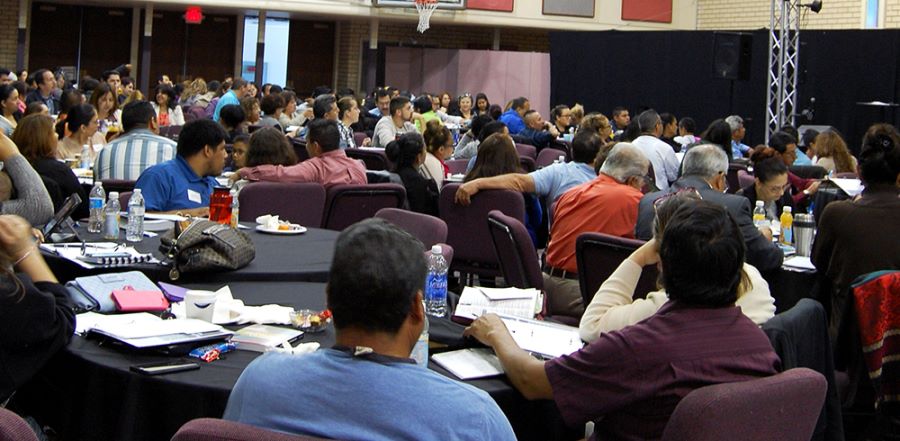
“We finished a strong 2016 season with great success,” says Winney, who worked with 26 churches throughout the year. “Then we used a church’s large gymnasium in Covina to introduce Acts 2 to more ministers and church leaders and the gym was packed.”
"Dr. George Winney is a true gift to the SoCal Network,” Guerra says. “He is a strategic thinker and able to help our pastors bridge the academic with the practical. He has been an inspiration to our Spanish pastors coaching them through the Acts 2 process in church revitalization.”
Pastor Daniel Elguezabal, who planted Centro Comunidad Familiar (Family Community Center), Bakersfield with his wife, Ruth, seven years ago, just finished going through an 8-month Acts 2 Journey in December.
“We had plateaued as a church,” Elguezabal says. “But now the church is more focused on our vision and operating in the five main functions of connect, go, serve, grow, and worship at all levels, even our kids.”
Elguezabal says that the church recently started a prison ministry, not only to reach inmates, but their families as well.
“The most important thing we learned,” he says, “is that we have to function in a way to cover all five areas at the same time. If we’re only serving and worshipping, that’s not going to do it — all five areas need to be working together in synchronization. Of course, that means that the Holy Spirit has to be in the middle of it all.”
In addition to helping churches with the Acts 2 Journey, Winney also offer churches what he offers businesses — strategic planning.
Although some people may wince when the words “business” and “church” are used in the same sentence, Winney believes that the giftings God has given him in these areas are not only sound business principles, but sound biblical principles.
“In the past, ministry used to be somewhat predictable,” Winney says. “You do things the way they’ve always been done and you experience success. That’s no longer the case.”
Winney explains that never before has there been such a large gap between generations. The new challenges millennials are facing and changing demographics have literally made some churches obsolete as the tools they’re using no longer speak to their community.
“One of the churches I pastor is Indio Assembly — it was founded in the 1950s,” Winney says. “When I started pastoring (about 8 years ago), only seven people were attending the church. What happened was over those decades, the community had changed — now it’s more than 75 percent Latino — but the church had not. One of the things we learned, after doing a demographic assessment, was that now a majority of the Latinos in our community were second and third generation who speak some Spanish, but have English as their first language. If we wanted to reach our community, including the first generation Latinos, we needed to be a bilingual church.” Today the church has an attendance of more than 200.
Even beyond demographics, for many churches, Winney has discovered some leaders simply don’t understand basic good business practices and too many pastors are hesitant to ask for help.
“Budgeting and establishing priorities are universal struggles that I’ve seen in the churches I’ve been working with,” Winney says. “Another struggle is leadership style. Many only know leadership from their parents or from their predecessor in the pulpit — some styles of leadership are simply not suitable for today’s church base.”
Winney explains it’s not about changing doctrine, but about the church knowing its community, its “clients” — including knowing what the community needs are and working to meet them, as well as staying abreast of changing needs.
Eliseo Simental, lead and founding pastor of Centro Familiar Cristiano (Family Christian Center) in Sylmar, agrees.
Simental explains that he saw “symptoms of plateau” in the church and knew he needed to reach out for help.
“Some of the key parts of the strategic plan for our church were to better serve our community and outreach in new and more relevant ways that appeal to our demographics,” Simental says. “We came to understand that the perception we had of our church was different than the perception that our community had of us.”
A few of the key adjustments for the church included communicating through social media, hosting a harvest festival for local families, and offering a fitness class to mothers, especially those who take their children to the nearby elementary school. The church is excited about the future and has embraced the essence of continuous improvement.
“One of the surprising benefits resulting from strategic planning is that people from our community, including local businesses, now want to collaborate with our church,” Simental says. “Strategic planning became a life saver for our church.”
Although strategic planning is a business for Winney, he says that when it comes to churches, he doesn’t charge full fare. “Some churches just cover my expenses, some also provide me a stipend,” he explains. “I do what I’m doing for churches as a ministry — money has never been a problem, even if a church thinks it is, we’ll find a way.”
Winney says that the Acts 2 Journey is a free service for ethnic churches through the SoCal Network, but it’s not that uncommon for him to add in some strategic planning skills for those churches in need of both disciplines.
“Dr. Winney is able to teach concepts in a way that both pastors and laymen are able to assimilate,” Guerra says. “Through his leadership, coaching, and training, he is helping us to create a leadership culture for our Anglo and Spanish churches.”
Yet, no matter what advice he offers, Winney wants to make one thing clear about the success churches are experiencing: “It’s not me. It’s God and the people in the church who do the work; I’m just a facilitator, but wherever I’m needed, I’ll go.”